
Truck Ladder Rack Materials Compared: Aluminum vs. Steel
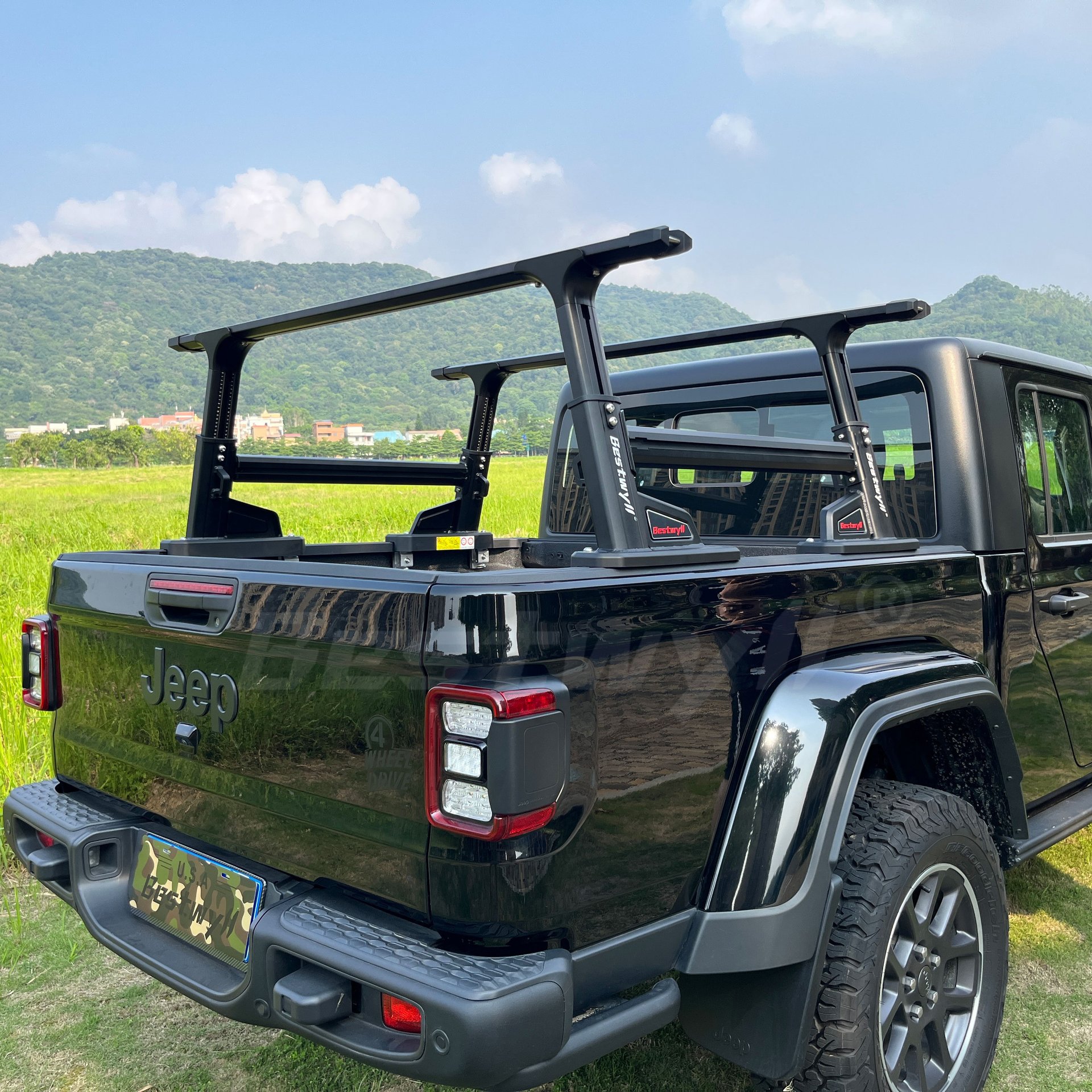
When distributors and retailers build a pickup truck accessory product line, truck ladder racks are often treated as a relatively simple product: choose a size, choose a load capacity, and compare prices.
In practice, material selection can have a major impact on product weight, durability, corrosion resistance, installation, retail positioning, shipping, and long-term customer satisfaction.
The most common materials are aluminum and steel, while some products also use hybrid constructions or other lightweight materials.
So, which material should distributors choose?
From our experience in the pickup accessory industry, aluminum truck racks are particularly attractive for distributors and retailers looking for a balance between strength, lightweight construction, corrosion resistance, appearance, and product flexibility. Steel still has a place, especially in certain heavy-duty applications where maximum load capacity and impact resistance are the priority.
The key is to match the rack material with the market you want to serve.
Quick Comparison: Truck Ladder Rack Materials
| Feature | Aluminum | Steel | Hybrid Construction |
|---|---|---|---|
| Weight | Lightweight | Heavy | Medium |
| Corrosion resistance | Excellent | Requires coating/protection | Depends on components |
| Load capacity | High when properly engineered | Very high potential | High |
| Installation handling | Easier | More difficult | Moderate |
| Outdoor use | Excellent | Good with proper coating | Good |
| Maintenance | Relatively low | Higher if coating is damaged | Moderate |
| Appearance | Modern / premium | Heavy-duty / industrial | Technical |
| Customization | Excellent | Excellent | Excellent |
| Shipping | Lower weight advantage | Higher shipping weight | Moderate |
| Retail positioning | Premium / practical | Heavy-duty / value | Premium |
| B2B applications | Commercial + outdoor | Heavy-duty commercial | Specialized |
The actual performance of any rack depends on its alloy, tubing/profile design, wall thickness, joints, brackets, mounting method, and tested load rating. Material alone should never be used as a substitute for product specifications.
1. Why Material Matters When Choosing a Truck Ladder Rack
A ladder rack has a relatively simple job:
Carry long or oversized cargo above the pickup bed while keeping the truck usable underneath.
But the rack may need to handle:
- Ladders
- Pipes
- Lumber
- Bicycles
- Kayaks
- Camping equipment
- Construction materials
- Long tools
- Outdoor gear
These applications place different demands on the structure.
For a distributor, material selection also affects the business side of the product:
- Factory cost
- Shipping cost
- Installation
- Inventory handling
- Product lifespan
- Warranty risk
- Target retail price
- Customer expectations
That is why we recommend evaluating material and application together, rather than simply asking a supplier for the cheapest truck rack.
2. Aluminum Truck Ladder Rack: Why Is It Popular?
Aluminum is widely used in pickup truck racks because it provides a useful combination of low weight and corrosion resistance.
Compared with steel, aluminum can significantly reduce the weight of the rack, making handling and installation easier. Industry product comparisons also commonly identify aluminum’s lightweight construction and corrosion resistance as key advantages.
For distributors, this creates several practical advantages.
Aluminum can be attractive for:
- Pickup accessory retailers
- Commercial vehicles
- Contractors
- Outdoor users
- Camping and overlanding
- Bicycle transportation
- Customers who frequently remove or install racks
- Markets with humid, rainy, coastal, or snowy conditions
In our opinion, weight is one of the most underestimated advantages of an aluminum truck rack.
A rack is an accessory, so customers generally don’t want the accessory itself to become an unnecessarily heavy burden on the vehicle.
3. Steel Truck Ladder Rack: Where Does It Make Sense?
Steel remains a popular material for truck ladder racks because it offers high structural strength, rigidity, and impact resistance.
Steel can be particularly attractive when customers regularly handle very heavy loads or operate in demanding commercial environments.
Some current ladder rack products use steel systems with substantially higher rated capacities than typical aluminum products. However, actual ratings vary significantly by design and should always be compared product by product.
Steel can be suitable for:
- Heavy-duty commercial fleets
- High-load applications
- Construction applications
- Customers prioritizing maximum rigidity
- Price-sensitive markets
The disadvantage is weight.
A steel rack can be significantly heavier than an aluminum equivalent, and its corrosion protection generally depends on coatings such as powder coating. If the coating is damaged, exposed steel can begin to corrode.
For distributors selling into coastal or high-humidity markets, this should be part of the product evaluation.
4. Aluminum vs. Steel: Weight
This is one of the clearest differences.
Aluminum has a much lower density than steel, so an aluminum rack can achieve a lower overall product weight when appropriately engineered.
For distributors, lower weight provides several practical benefits:
Easier warehouse handling
Employees can move and organize products more easily.
Easier installation
A lighter rack can be easier for installers to position on a pickup.
Easier removal
Customers who use a rack seasonally may appreciate being able to remove it without heavy equipment.
Lower shipping weight
For international distributors, product weight can influence transportation costs and container planning.
Some industry comparisons report aluminum ladder racks being roughly 30–50% lighter than comparable steel constructions, although the exact difference depends heavily on rack design and dimensions.
For B2B buyers, the important point is not the exact percentage. Ask the supplier for the actual net weight and packaged weight of the finished product.
5. Corrosion Resistance: A Major Advantage of Aluminum
For a pickup accessory that spends its life outdoors, corrosion resistance matters.
A truck rack can be exposed to:
- Rain
- Snow
- Road salt
- Humidity
- Mud
- Coastal air
- Washing chemicals
Aluminum naturally forms a protective oxide layer and does not develop rust in the same way that exposed steel does. Steel racks generally rely on protective coatings, and damage to those coatings can create corrosion points.
This makes aluminum particularly attractive for:
Coastal markets
High-humidity markets
Snow-belt markets
Outdoor-use products
For retailers, corrosion resistance can also become a straightforward sales benefit:
“Lightweight aluminum construction designed for long-term outdoor use.”
That is easier for customers to understand than a complicated technical material description.
6. Aluminum Is Excellent for Outdoor and Recreational Applications
A modern pickup is not only a work vehicle.
Many customers use their trucks for:
- Cycling
- Camping
- Fishing
- Kayaking
- Overlanding
- Surfing
- Hunting
- Outdoor travel
This creates an opportunity for distributors to position truck racks beyond traditional construction applications.
For example:
Aluminum Truck Rack + Bicycle
A lightweight rack can provide an elevated carrying solution while keeping the truck bed available for luggage and equipment.
Aluminum Truck Rack + Camping Gear
Customers can use the rack for longer or oversized equipment while maintaining covered or open storage below.
Aluminum Truck Rack + Tonneau Cover
A compatible rack and tonneau cover combination allows the customer to protect cargo inside the bed while transporting additional equipment above it.
This last combination is particularly interesting for pickup accessory retailers.
7. Adjustable Aluminum Truck Racks Offer an Important B2B Advantage
For wholesalers and distributors, adjustability can be more valuable than it initially appears.
Pickup truck beds vary in width and configuration.
A fixed-size rack may only fit a limited range of applications.
An adjustable rack can potentially serve more vehicle configurations.
For example, Bestwyll’s truck ladder rack solution has an adjustable length range of 1130–1860 mm, while the compatible Bestwyll retractable tonneau cover range is specified at 1250–1980 mm.
For a distributor, this type of adjustability can provide:
- Broader vehicle application
- More flexible inventory
- Easier product positioning
- More potential customers
- More opportunities for bundling
This is one reason we consider adjustability a commercial feature, not simply a technical feature.
8. Aluminum Truck Rack vs. Steel: Installation
Weight also affects installation.
A heavy steel rack can require more effort to position and install, particularly for smaller retail workshops.
A lighter aluminum structure can be easier to handle.
This can be particularly useful for distributors supplying products to:
- Automotive accessory stores
- Pickup dealerships
- Small installers
- Independent workshops
- DIY-oriented customers
Some truck racks use no-drill mounting systems, while others require permanent drilling or specialized mounting. This is independent of whether the rack is aluminum or steel, so distributors should evaluate the mounting method separately from the material.
9. No-Drill Installation Can Increase Retail Appeal
If a truck rack can be installed without drilling, it creates another strong selling point.
Customers may be concerned about:
- Permanent vehicle modification
- Resale value
- Installation time
- Vehicle damage
- Removing the rack later
A well-designed no-drill mounting system can address some of these concerns.
For retailers, it also means:
Less installation complexity → easier sales → potentially lower installation labor.
However, distributors should verify the specific vehicle application rather than assuming that every rack labeled “no-drill” is compatible with every pickup.
10. Which Material Is Better for Distributors?
Rather than asking which material is universally better, consider the target market.
Choose aluminum when customers prioritize:
- Lightweight construction
- Corrosion resistance
- Outdoor use
- Easy handling
- Modern appearance
- Flexible applications
- Compatibility with other pickup accessories
- Long-term outdoor use
Consider steel when customers prioritize:
- Very high load requirements
- Maximum rigidity
- High-impact commercial environments
- Lower initial purchase price
This distinction is important.
A distributor shouldn’t necessarily sell the strongest rack on paper.
The better product is the one that matches the customer’s actual application while leaving enough margin for the retailer.
11. Bestwyll Aluminum Truck Rack: Designed for More Flexible Pickup Applications
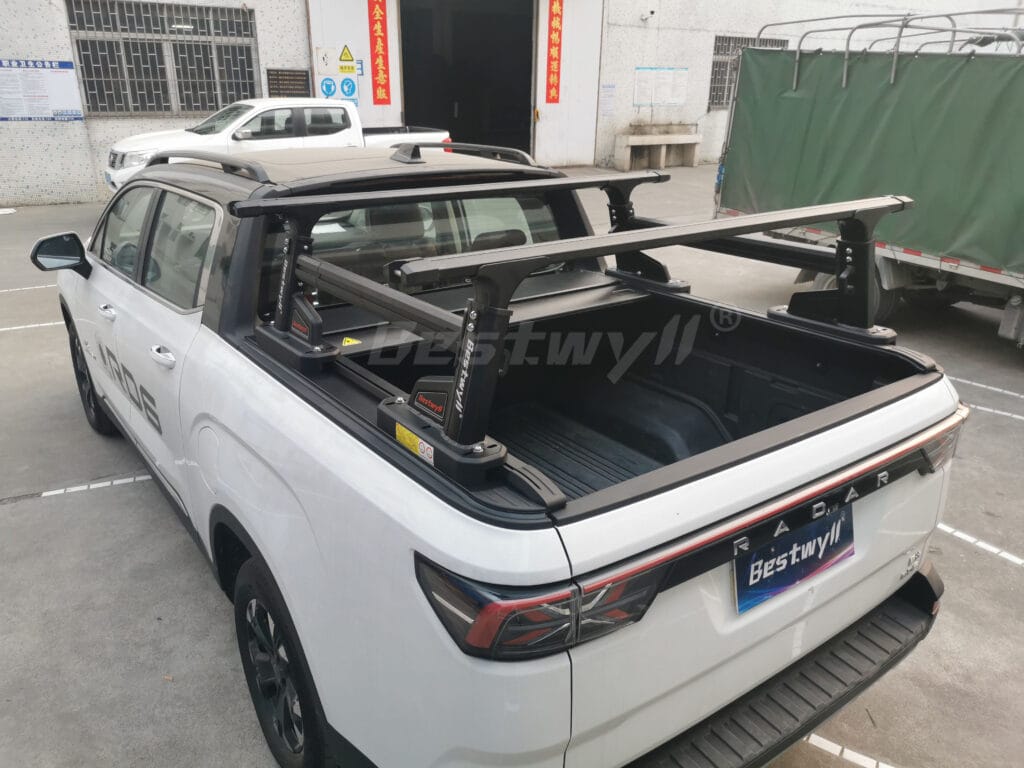
For distributors and retailers looking for an aluminum truck rack solution, Bestwyll Aluminum Truck Rack is designed around the practical needs of modern pickup users.
The rack uses 6-series aluminum alloy, with an adjustable length of approximately 1130–1860 mm. It is designed for high load-bearing performance and can be used with compatible Bestwyll retractable tonneau covers or as a standalone rack.
This gives distributors two important sales configurations:
Configuration 1
Truck Rack + Retractable Tonneau Cover
A solution for customers who need:
- Protected cargo storage
- External cargo carrying
- Flexible pickup-bed access
Configuration 2
Truck Rack as a Standalone Product
Suitable for customers who primarily need:
- Bicycles
- Long equipment
- Outdoor gear
- Oversized cargo
This flexibility can make the product easier for retailers to position across different customer segments.
12. Why 6-Series Aluminum Is Attractive for B2B Buyers
When sourcing aluminum racks, the material specification matters.
“Aluminum” is a very broad description.
Bestwyll’s truck rack uses 6-series aluminum alloy, providing a stronger technical specification for distributors to communicate than simply calling the product “an aluminum rack.”
For B2B buyers, this makes it easier to build product content around:
- Aluminum construction
- Lightweight design
- Structural performance
- Corrosion resistance
- Outdoor use
- Premium positioning
However, retailers should still communicate load ratings according to the manufacturer’s official specifications rather than making generalized claims about aluminum strength.
Conclusion: Which Truck Ladder Rack Material Should You Choose?
There is no single material that is ideal for every truck rack application.
Steel can make sense when maximum rigidity, high load capacity, impact resistance, or lower initial cost is the primary consideration.
Aluminum is particularly attractive when the market values:
- Lightweight construction
- Corrosion resistance
- Easier installation
- Outdoor durability
- Modern appearance
- Adjustable configurations
- Compatibility with tonneau covers
- Broader pickup applications
For distributors and retailers, we believe aluminum offers an especially strong combination of commercial and technical advantages for a premium pickup accessory product line.
And rather than evaluating a rack only by its material, we recommend looking at the complete package:
Material + Structure + Load Capacity + Fitment + Installation + Adjustability + Accessory Compatibility + After-Sales Support
For B2B buyers looking to expand their pickup accessory range, Bestwyll Aluminum Truck Rack is worth considering as a product that can be positioned across both commercial and outdoor pickup applications.