
Does a Pickup Truck Canopy Need Drilling? A Guide to No-Drill Installation

When distributors and retailers source pickup truck canopies, installation is often overlooked during the initial product evaluation.
Buyers usually focus on material, appearance, load capacity, waterproofing, and price. But once the product reaches the customer, one question can have a major impact on satisfaction:
Does the pickup truck canopy require drilling?
For many aftermarket customers, the answer matters a lot.
A no-drill truck canopy can offer a faster installation process, reduce permanent vehicle modifications, and make the product easier for retailers to sell and install. However, “no-drill” should not simply be treated as a marketing phrase. The mounting structure, brackets, truck-bed design, load requirements, and installation quality all need to work together.
For distributors and retailers, understanding how no-drill installation works—and where its limitations are—can help reduce installation problems, warranty claims, and customer complaints.
Does a Pickup Truck Canopy Need Drilling?
Not necessarily.
Some pickup truck canopies are designed to be installed without drilling into the truck body or bed. These systems typically use specially designed brackets, clamps, rails, or existing mounting points to secure the canopy.
However, not every canopy is no-drill.
Whether drilling is required depends on:
- Canopy design
- Truck model
- Bed configuration
- Mounting system
- Bracket design
- Accessory configuration
- Manufacturer’s installation requirements
Therefore, distributors should never assume that a canopy is no-drill simply because the product description says “easy installation.”
The supplier should clearly specify how the canopy is mounted.
Why Is No-Drill Installation Important for Distributors?
For an individual customer, no-drill installation can mean a simpler installation experience.
For a retailer or distributor, the benefits can be much broader.
A no-drill canopy can potentially reduce:
- Installation time
- Labor costs
- Installation errors
- Vehicle modification concerns
- Customer waiting time
- After-sales complaints
This makes installation design a commercial consideration—not simply a technical feature.
From our experience with pickup accessories, the easier a product is to install correctly, the easier it is for a retailer to sell at scale.
If a workshop needs several hours and specialized tools to install every canopy, installation becomes a significant part of the product cost.
If the product can be securely installed using a well-designed no-drill mounting system, the retailer has much more flexibility.
1. How Does a No-Drill Truck Canopy Work?
A no-drill canopy generally uses a mounting system that secures the structure to the pickup without requiring new holes to be drilled into the truck body.
Depending on the design, the system may use:
- Clamping brackets
- Bed-rail mounting points
- Existing mounting locations
- Dedicated vehicle-specific brackets
- Internal support structures
- Mechanical fasteners
The exact method varies between manufacturers and vehicle models.
The important point is that the canopy must still be mechanically secure.
No-drill does not mean:
“No hardware.”
It means:
The canopy can be securely installed without drilling new holes into the vehicle.
This distinction is important when explaining the product to customers.
2. No-Drill Does Not Mean No Installation Requirements
One common misconception is that a no-drill canopy can simply be placed on the truck and tightened.
That is not how a professional installation should work.
Even a no-drill system requires:
- Correct positioning
- Proper bracket alignment
- Correct tightening
- Adequate contact between mounting surfaces
- Appropriate torque where specified
- Correct sealing
- Inspection after installation
A poorly installed no-drill canopy can still move, leak, or develop problems.
For retailers, this means that installation quality remains important even when drilling is not required.
3. Why Customers Prefer No-Drill Installation
There are several reasons no-drill systems are attractive to pickup owners.
1. Less permanent modification
Many truck owners do not want to drill into a relatively new vehicle.
A no-drill system can reduce concerns about permanent modifications.
2. Faster installation
With the right mounting design, installation can generally be completed more efficiently than systems requiring additional fabrication or drilling.
3. Easier removal
Some customers may eventually want to remove the canopy or transfer it to another vehicle.
A removable mounting system can make this process easier.
4. Lower installation risk
Drilling requires accurate positioning.
A mistake can potentially damage the vehicle or create unwanted holes.
Eliminating unnecessary drilling can reduce this particular installation risk.
4. Load Capacity Still Matters
A canopy can be no-drill and still be designed for substantial loads.
But distributors should not assume that a no-drill system automatically has a particular load rating.
The supplier should provide specific information regarding:
- Static load capacity
- Dynamic load capacity
- Roof load
- Accessory load
- Cross-bar compatibility
- Driving conditions
- Recommended mounting configuration
For example, Bestwyll’s supplied canopy specifications include a 500 kg static load capacity and 250 kg dynamic load capacity.
These figures should be communicated according to the manufacturer’s specified test conditions and application requirements rather than being treated as universal values for every truck canopy.
5. No-Drill Installation Can Reduce Installation Costs
For a retailer, installation time is money.
Imagine a shop installing multiple canopies every week.
If each installation requires:
- Measuring
- Drilling
- Cutting
- Fabricating brackets
- Treating drilled areas
- Additional sealing
labor costs can quickly increase.
A well-designed no-drill system can simplify the process.
The potential commercial benefits include:
- Shorter installation time
- More efficient workshop scheduling
- Lower labor requirements
- Easier staff training
- Fewer installation variables
This is one reason we believe installation design should be part of a distributor’s product evaluation, rather than something considered only after the product has been purchased.
6. No-Drill Systems Can Help Reduce After-Sales Problems
Installation errors are a common source of aftermarket complaints.
A drilling mistake can potentially cause:
- Misaligned mounting
- Poor sealing
- Unwanted holes
- Water leakage
- Cosmetic damage
A no-drill system can eliminate some of these potential problems.
However, it does not eliminate all installation risks.
For example, incorrect bracket positioning or insufficient tightening can still create problems.
This is why a good supplier should provide:
- Installation instructions
- Vehicle-specific mounting information
- Installation diagrams
- Hardware specifications
- Torque recommendations where applicable
- Troubleshooting guidance
7. What Does a Good No-Drill Installation Process Look Like?
While the exact procedure varies by product and vehicle, a professional no-drill installation generally follows a logical sequence.
Step 1: Confirm vehicle compatibility
Check:
- Truck model
- Model year
- Bed length
- Bed configuration
- Existing accessories
Step 2: Prepare the truck
Clean the relevant mounting areas and remove anything that may interfere with the brackets.
Step 3: Position the canopy
Place the canopy correctly and check alignment.
Step 4: Install the mounting hardware
Install the supplied brackets or clamps according to the manufacturer’s instructions.
Step 5: Check alignment
Make sure the canopy is centered and correctly positioned relative to the truck bed.
Step 6: Tighten the mounting system
Tighten all hardware according to the manufacturer’s specifications.
Step 7: Check sealing
Inspect the contact areas, seals, doors, and other potential water-entry points.
Step 8: Test the complete system
Open and close the canopy doors, check clearance, inspect the mounting points, and verify that compatible accessories operate normally.
The exact procedure should always follow the supplier’s installation instructions.
8. Can a No-Drill Canopy Be Removed Later?
In many cases, a properly designed no-drill canopy can be removed without leaving newly drilled holes in the vehicle.
This can be attractive for:
- Lease vehicles
- Company fleets
- Customers who frequently change vehicles
- Used-vehicle owners
- Customers who want flexibility
For distributors, this also makes the product easier to position as a reversible aftermarket upgrade.
However, retailers should avoid promising completely “damage-free removal” unless the manufacturer specifically guarantees it. Existing vehicle mounting points, clamps, protective pads, or accessories can still leave marks depending on the installation.
9. Aluminum Is Particularly Suitable for Modular Canopy Design
No-drill installation works particularly well when combined with a modular canopy structure.
Aluminum canopies can be engineered with:
- Separate panels
- Reinforced mounting points
- Modular brackets
- Replaceable components
- Side accessories
- Cross-bar mounting systems
This gives manufacturers more flexibility when developing different configurations.
For OEM/ODM customers, this is especially valuable.
A distributor may want:
- Different side panels
- Different windows
- Custom branding
- Different rack configurations
- Vehicle-specific brackets
- Different roof accessories
A modular aluminum structure can make these requirements easier to accommodate.
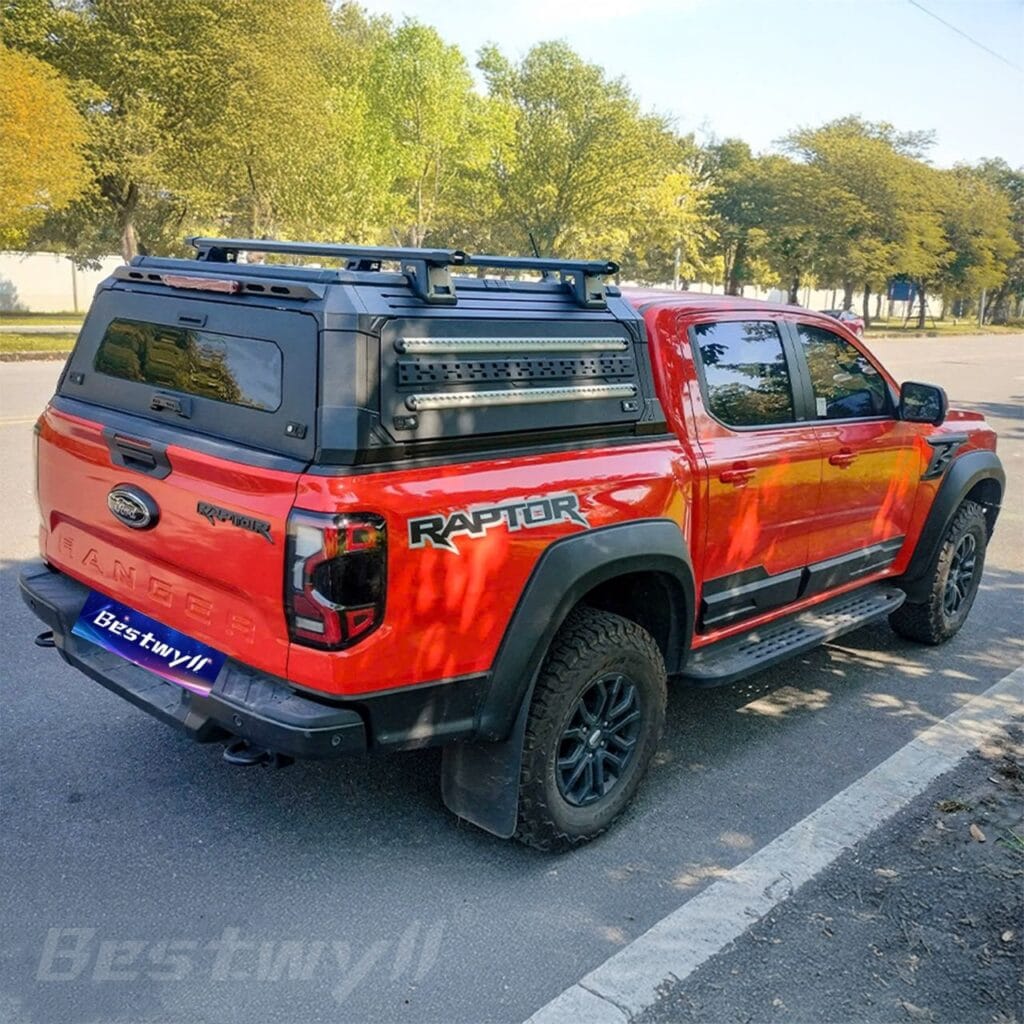
10. Why Choose Bestwyll for No-Drill Pickup Truck Canopies?
Bestwyll develops pickup truck accessories for international distributors, wholesalers, retailers, and OEM/ODM customers.
Our pickup canopy solutions are designed around practical aftermarket requirements, including:
- Aluminum construction
- No-drill installation
- Waterproof and ventilated design
- High load capacity
- Customizable side panels
- Optional side racks or glass
- Cross-bar compatibility
- Practical maintenance
With more than 20 years of experience in the pickup accessory industry, our approach is to develop products that are not only visually appealing but also practical for real-world use.
For B2B customers, this means considering the complete product lifecycle:
Product design → Installation → Daily use → Maintenance → After-sales support
We believe this is particularly important when developing a long-term pickup accessory product line.
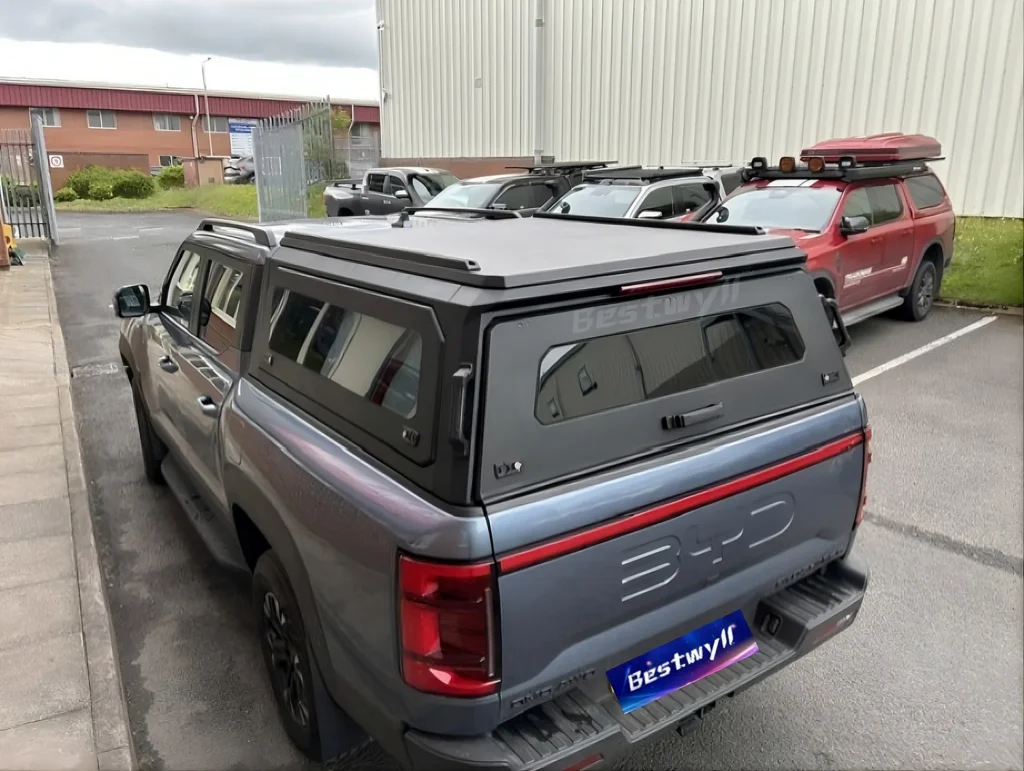
Conclusion: No-Drill Installation Can Be a Real Competitive Advantage
So, does a pickup truck canopy need drilling?
Not always.
A properly designed no-drill pickup truck canopy can be securely mounted using engineered brackets, clamps, or existing mounting points, depending on the vehicle and product design.
For distributors and retailers, the benefits can extend beyond easier installation.
A well-designed no-drill system can help provide:
- Faster installation
- Lower installation complexity
- Fewer permanent vehicle modifications
- Easier product removal
- Lower potential installation risk
- Better retail positioning
- More attractive aftermarket applications
But the most important point is this:
“No-drill” should never be evaluated as an isolated marketing feature.
Distributors should evaluate the entire system:
Mounting Design + Vehicle Fitment + Structural Strength + Load Capacity + Waterproofing + Accessory Compatibility + Installation + After-Sales Support
When these elements work together, a no-drill canopy can become a valuable product for both retailers and end customers.
For B2B buyers looking to build a competitive pickup accessory portfolio, easy installation is not just a customer convenience—it can be a genuine commercial advantage.